
AKS Risk Assessment for SNFs: Turning OIG Guidance Into Action
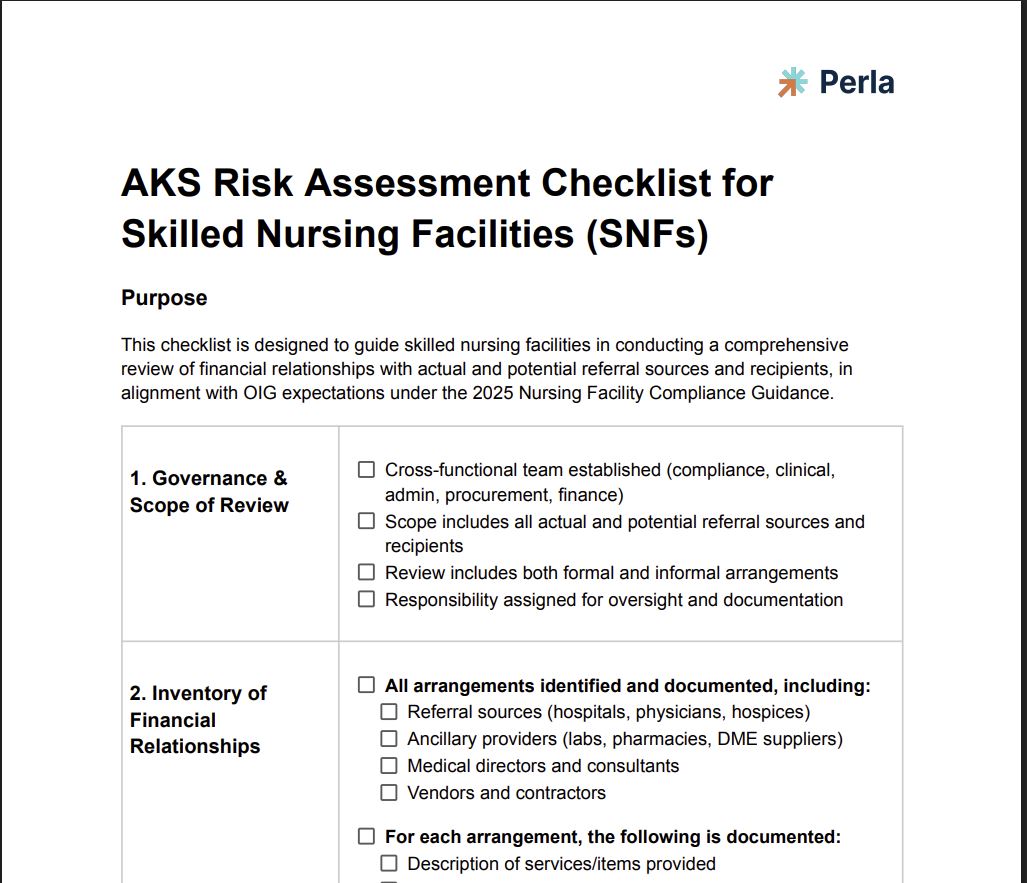
This article outlines a practical framework for skilled nursing facilities to assess Anti-Kickback Statute risk under the OIG’s 2025 Nursing Facility Guidance. It provides a structured, interdisciplinary approach to evaluating referral relationships, aligning arrangements with safe harbors, and implementing ongoing monitoring to support a defensible and operational compliance program.
AKS Risk Assessment Tool Kit
We have created tools to help you with performing and tracking your AKS risk assessments.
- AKS Risk Assessment Checklist (PDF)
- AKS Risk Assessment Tracker (Excel)
Download your AKS Risk Assessment Tool Kit
Introduction: Moving Beyond Policy to Practice
In our prior article, we examined the Office of Inspector General’s (“OIG”) 2024 Nursing Facility Industry Segment-Specific Compliance Program Guidance (“NF ICPG”) and its implications for Anti-Kickback Statute (“AKS”) compliance. That discussion focused on the scope of the guidance and key risk areas identified by the OIG. A natural next step for skilled nursing facilities (“SNFs”), however, is determining how to translate those expectations into a practical and defensible compliance process.
The NF ICPG makes clear that enforcement risk increasingly turns not on the existence of written policies, but on how organizations identify, evaluate, and manage financial relationships in practice. In particular, arrangements involving referral sources, vendors, and ancillary service providers continue to present heightened scrutiny where remuneration could influence clinical or business decision-making. Against this backdrop, SNFs should adopt a structured and interdisciplinary risk assessment framework that is both comprehensive and operationally grounded.
Establishing a Cross-Functional and Holistic Review Process
A threshold requirement of any effective AKS risk assessment is the involvement of appropriate stakeholders across the organization. Compliance teams should work in coordination with clinical and administrative leadership, ordering providers, and procurement personnel to undertake a holistic review of relationships with actual and potential referral sources and recipients.
This interdisciplinary approach is essential. Financial arrangements that appear compliant in isolation may raise concerns when evaluated alongside referral patterns, clinical utilization, or procurement practices. Conversely, operational realities may justify certain arrangements that would otherwise appear high-risk if viewed solely through a contractual lens. A coordinated review ensures that each relationship is evaluated in light of its full clinical, financial, and operational context.
Developing a Comprehensive Inventory of Arrangements
As a foundational step, facilities should identify and inventory all existing financial arrangements, including those with:
- Referral sources and recipients
- Ancillary service providers (e.g., laboratories, pharmacies, DME suppliers)
- Medical directors, consultants, and contractors
- Vendors and other third-party partners
This inventory should extend beyond formal agreements to include informal or evolving arrangements that may carry compliance implications. For each relationship, facilities should document the structure, compensation methodology, services provided, and any connection to federal health care program (“FHCP”) referrals. Without this level of visibility, meaningful risk assessment is not possible.
Evaluating Safe Harbor Protection and Ongoing Compliance
Following identification, each arrangement should be evaluated to determine whether it was originally structured to comply with an applicable AKS exception or regulatory safe harbor, such as those relating to discounts, space or equipment rental, personal services and management contracts, or employment.
Where an arrangement was intended to meet a safe harbor, the analysis should not end there. Facilities must assess whether the conditions necessary for protection continue to be satisfied in practice. This includes evaluating whether:
- The terms of the written agreement remain consistent with how the arrangement is actually performed
- Compensation remains consistent with fair market value (“FMV”)
- The services or items are still necessary and are in fact being provided
- Supporting documentation exists (e.g., time logs, invoices, or other records substantiating payment)
This step is critical, as arrangements frequently drift over time, creating compliance risk even where the original structure was appropriate.
Assessing Risk Where Safe Harbor Protection Is Absent
Where an arrangement was not structured to comply with a safe harbor, facilities should undertake a more searching inquiry into whether it presents AKS risk. The OIG has identified a number of relevant considerations in both the NF ICPG and prior guidance, including whether the arrangement could be viewed as inducing or rewarding referrals.
This analysis should focus on substance over form. Even common industry arrangements may raise risk where compensation is not commercially reasonable, where services lack a legitimate business purpose, or where there is an implicit connection between remuneration and referral activity.
Restructuring Arrangements to Achieve Compliance
Where risks are identified, facilities should evaluate whether the arrangement can be modified to align with an applicable safe harbor or otherwise reduce risk exposure. In many cases, relatively targeted changes may be sufficient, such as:
- Adjusting compensation to align with FMV
- Revising contractual terms to reflect current operational realities
- Clarifying the scope and necessity of services
Particular attention should be paid to arrangements involving free or below-market goods or services. In such cases, facilities should consider whether the same economic objectives can be achieved through compliant structures. For example, in-kind benefits provided in connection with service agreements may, in some cases, be replaced with compliant discount structures.
Similarly, certain in-kind arrangements—such as services provided to facilitate patient transitions—may potentially be restructured to meet applicable safe harbors for care coordination or patient engagement, provided all regulatory conditions are satisfied.
Addressing High-Risk Financial Relationships and “Swapping” Concerns
The NF ICPG also highlights the importance of scrutinizing relationships with ancillary service providers and suppliers, particularly in light of potential “swapping” concerns. Facilities should carefully evaluate whether compensation for services furnished to Part A patients is consistent with FMV and not conditioned on, or designed to induce, referrals for services separately billable to FHCPs.
In addition, specific attention should be given to bed hold and reservation arrangements. These arrangements should be reviewed to ensure compliance with applicable CMS requirements, that payments are not excessive, and that beds are not improperly reserved (e.g., for already-occupied patients or beyond actual need).
Implementing Prospective Controls and Screening Mechanisms
Beyond retrospective review, SNFs should develop or reinforce processes to screen new and proposed arrangements for AKS risk prior to execution. To the extent possible, new arrangements should be structured to satisfy all elements of an applicable safe harbor at the outset.
This prospective approach is essential to preventing the introduction of new risk into the organization and demonstrates a proactive compliance posture aligned with OIG expectations.
Strengthening Conflict-of-Interest Oversight
An effective risk assessment framework must also address potential conflicts of interest. Facilities should implement robust disclosure and management processes requiring clinical and administrative decision-makers to disclose any financial relationships with actual or potential referral sources or recipients.
This is particularly important in relationships involving long-term care pharmacies, therapy providers, and other vendors with referral influence. Once identified, conflicts should be actively managed through appropriate safeguards, which may include recusal, enhanced review, or restructuring of the underlying arrangement.
Ongoing Monitoring and Integration into Compliance Governance
Finally, risk assessment should be treated as an ongoing function rather than a one-time exercise. Facilities should incorporate periodic review of arrangements into their compliance programs, with clear reporting lines to compliance committees and leadership.
As relationships evolve and new partnerships are formed, continuous monitoring ensures that compliance keeps pace with operational changes and that previously compliant arrangements do not become problematic over time.
Conclusion: Building a Defensible and Sustainable Compliance Framework
The NF ICPG reflects a broader shift toward evaluating how compliance programs function in practice. For SNFs, this means moving beyond policy development to the implementation of structured, interdisciplinary processes that can withstand regulatory scrutiny.
By undertaking a holistic review of referral relationships, aligning arrangements with safe harbor requirements where possible, and embedding ongoing monitoring into their compliance infrastructure, facilities can establish a defensible and sustainable approach to AKS compliance—one that not only mitigates legal risk but also supports sound clinical and operational decision-making.
Related Posts
.jpg)

Take Your Practice to the Next Level
Get started with Perla platform and grow your practice.
Book a Demo